
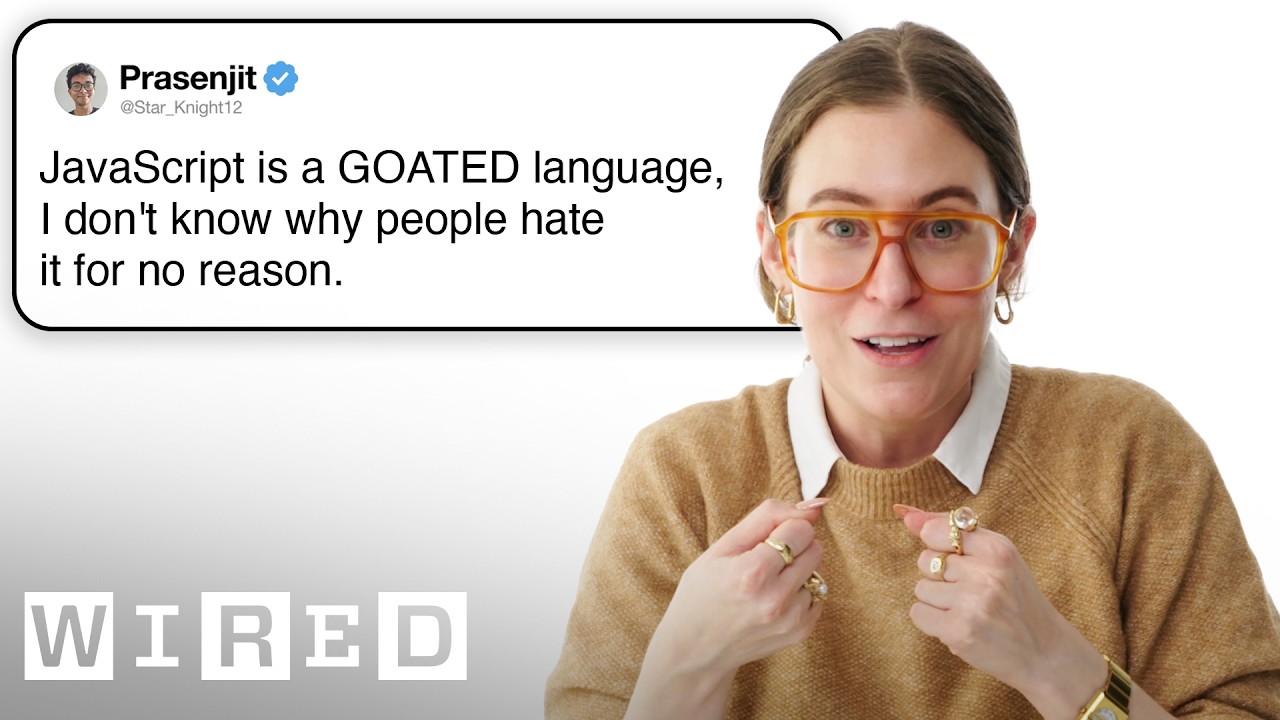
UC Berkeley Computer Science Professor Sarah Chasins joins WIRED to answer the internet’s burning questions about coding. How did programmers code the first ever code? What remnants of the early World Wide Web still exist online? Can someone still learn programming if they hate math? How do new programming languages get made? Why is debugging harder than writing code? How can computer scientists contribute to CRISPR? Professor Chasins answers these questions any many more on this episode of WIRED Tech Support: Coding Support.
0:00 Coding Support
0:16 Remnants of the early web
1:04 y so hard
1:21 Can I still learn programming if I hate math?
2:09 The first computer viruses
2:39 How did programmers code the first ever code?
4:10 The difference between programming languages
5:21 What would you say…you do here
5:58 Python
6:27 C + +
6:45 Beloved Rust
7:52 JavaScript: GOATED?
8:16 How programming languages get made
9:12 01101000 01100001 01101000 01100001 00100000 01101110 01100101 01110010 01100100
10:47 Why is debugging harder than writing code?
11:44 Syntax
12:08 Backend, frontend or full-stack?
12:27 How can computer scientists contribute to CRISPR?
13:32 How hard would it be to build my own game engine from scratch?
14:49 ChatGPT
17:31 Is it worth learning to code with AI advancing so fast?
19:10 What is the best way of using Al while coding?
20:19 “Vibe coding”
21:19 Live coding demonstration
28:22 How do I read code?
29:22 How do computers “understand” code?
Director: Justin Wolfson
Director of Photography: AJ Young
Editor: Richard Trammell
Expert: Sarah Chasins
Line Producer: Jamie Rasmussen
Associate Producer: Brandon White; Paul Guylas
Production Manager: Jonathan Rinkerman
Casting Producer: Nick Sawyer
Camera Operator: Nick Massey
Sound Mixer: Gloria “Glo” Hernandez
Production Assistant: Fernando Barajas
Post Production Supervisor: Christian Olguin
Post Production Coordinator: Stella Shortino
Supervising Editor: Eduardo Araujo
Assistant Editor: Billy Ward
Still haven’t subscribed to WIRED on YouTube? ►► http://wrd.cm/15fP7B7
Listen to the Get WIRED podcast ►► https://link.chtbl.com/wired-ytc-desc
Want more WIRED? Get the magazine ►► https://subscribe.wired.com/subscribe/splits/wired/WIR_YouTube?source=EDT_WIR_YouTube_0_Video_Description_ZZ
Follow WIRED:
Instagram ►►https://instagram.com/wired
Twitter ►►http://www.twitter.com/wired
Facebook ►►https://www.facebook.com/wired
Tik Tok ►►https://www.tiktok.com/@wired
Get more incredible stories on science and tech with our daily newsletter: https://wrd.cm/DailyYT
Also, check out the free WIRED channel on Roku, Apple TV, Amazon Fire TV, and Android TV.
ABOUT WIRED
WIRED is where tomorrow is realized. Through thought-provoking stories and videos, WIRED explores the future of business, innovation, and culture.




7:00 Good note about error messages. Programmers spend a significant amount of time debugging and troubleshooting, and good error messages can make or break that process. C is an incredibly simple and powerful language, but it takes orders of magnitude more time to diagnose a Segfault than it does to identify a problem in a language that does proper error reporting.
Very sweet girl, like david fron cs50. Wish i had professors like you
Very interesting!
These ugly glasses really put me off though 😅
Hmm, I was wondering how she is a professor. Then I remembered that in english professor has no meaning because of misuse and looked it up. She’s a lecturer and professor intern. English is a joke of a language :-/
Her hands are shaking.
9:20 oh my god. shes the goat. best explanation. i absolutely loved this video, and her.
Never heard someone say oneth instead of first until now
What a wonderful video. Her enthusiasm and expertise make this a must watch for anyone in the industry currently, on the way out, or considering coming in. Very clear and simple to digest.
‘If it always this difficult?’ – Yes and it should be. If on some point you get comfy and it start being easy for you, than you doing something wrong and you stop growing as professional, go and teach others to code :)) Coding industry is always going forward and it is growing, and you must go forward and grow… Until you start to become less like human and more like algoritm, after 10 years in industry or so… On that point you are losing your mind, so go on retirement and farm goose or so…. That is THE WAY, the only way…
Anything that can be written in JS will eventually be written in JS