
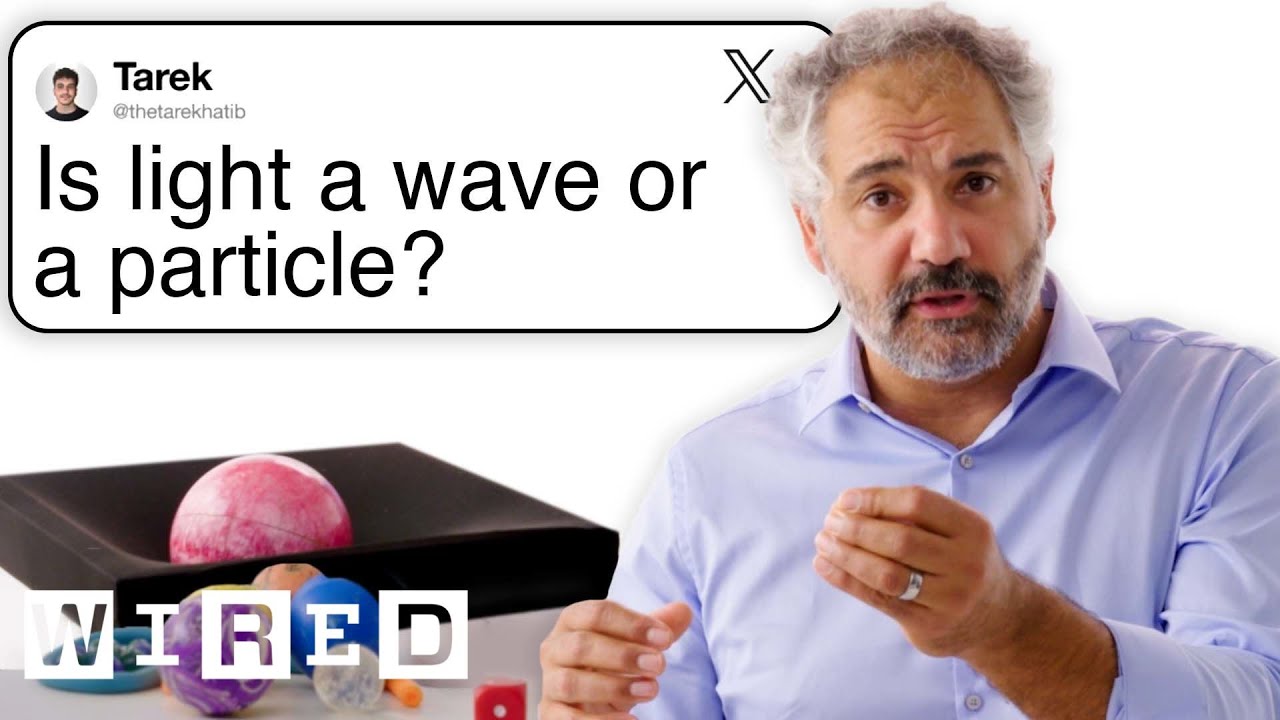
Physicist Jeffrey Hazboun visits WIRED to answer the internet’s swirling questions about physics. How does one split an atom? Is light a wave or a particle…or both? How soon will the universe end? Is time travel is possible given physicists’ current understanding? What’s the deal with string theory?
Director: Lisandro Perez-Rey
Director of Photography: AJ Young
Editor: Marcus Niehaus
Talent: Jeffrey Hazboun
Creative Producer: Justin Wolfson
Line Producer: Joseph Buscemi
Associate Producer: Paul Gulyas
Production Manager: Peter Brunette
Production and Equipment Manager: Kevin Balash
Casting Producer: Vanessa Brown
Camera Operator: Lucas Vilicich
Sound Mixer: Kara Johnson
Production Assistant: Fernando Barajas
Post Production Supervisor: Alexa Deutsch
Post Production Coordinator: Ian Bryant
Supervising Editor: Doug Larsen
Additional Editor: Paul Tael
Assistant Editor: Billy Ward
Still haven’t subscribed to WIRED on YouTube? ►► http://wrd.cm/15fP7B7
Listen to the Get WIRED podcast ►► https://link.chtbl.com/wired-ytc-desc
Want more WIRED? Get the magazine ►► https://subscribe.wired.com/subscribe/splits/wired/WIR_YouTube?source=EDT_WIR_YouTube_0_Video_Description_ZZ
Follow WIRED:
Instagram ►►https://instagram.com/wired
Twitter ►►http://www.twitter.com/wired
Facebook ►►https://www.facebook.com/wired
Tik Tok ►►https://www.tiktok.com/@wired
Get more incredible stories on science and tech with our daily newsletter: https://wrd.cm/DailyYT
Also, check out the free WIRED channel on Roku, Apple TV, Amazon Fire TV, and Android TV.
ABOUT WIRED
WIRED is where tomorrow is realized. Through thought-provoking stories and videos, WIRED explores the future of business, innovation, and culture.



I feel like Donald Trump is bent.
@9:50 was indeed not simple to write
I studied physics and calculus in college, but ultimately had to drop out because my anxiety and attention deficit just wouldn’t permit it. I could sit and listen to this person forever.
Don’t listen too intently. Some of the answers are really, really wrong.
@lepidoptera9337 Are they? Like what?
@chodetaculous The wave particle duality question is 100% false. Light is neither a wave nor a particle. A black hole is not a sphere, either. Only the theoretical Schwarzschild black hole has spherical symmetry, but they don’t exist in nature. Almost all real black holes seem to have nearly maximal angular momentum. The common lore is that they are oblate spheroids, but that isn’t true, either. First of all they have two horizons and not one, i.e. their behavior is different for light than it is for matter and frame dragging makes the idea of a static horizon as some sort of geometric surface completely irrelevant. Even if we treat the geometry by neglecting reality almost completely, the resulting shape is NOT a spheroid.
@lepidoptera9337 I appreciate the answer. I was afraid you were going to say something along the lines of “its magic.”
@chodetaculous Physics is not magic. It does have a lot of important details and many physicists believe that they are good teachers by glossing over the necessary level of detail. These folks are causing a lot of harm to both science and the interested public. Of course physics looks like a mess if we leave out 99% of the details. Everything looks like a mess if it’s being oversimplified beyond recognition.
How have you weathered the Trump cuts to science? ✂️
Did you use a panel with “a” slit or two slits? You seemed to indicate you used one slit but the diagram showed two slits.
Got to find some exotic stuff 😂
The thing about the dual slit experiment that makes it really interesting is the fact that the interference pattern will still show up when you only shoot a single particle. I can’t believe he glossed over this as it’s a massive deal. It demonstrates wave particle duality, and quantum effects, one of the most interesting experiments in all of physics, it’s what got me interested in it.
he’s making a lot of assumptions rather than saying, we just don’t know.
As with the wave/particle question, the thing I most enjoy about physics is when the answer to either/or questions is, “yes”. 🤷
Wired please talk about how we will cure blindness caused by RETINAL VEIN OCCLUSION
6:28 By then we would have learned how to provoke the next Big Bang. That’s the reason for our existence. Just like biological life perpetuates itself, we are here to make sure the Universe has a baby.
Wasn’t the heat death much more far away? Like trillions and trillions of years away?
5:21 I think he answered my question. How do I pay him the $1000?
0:04 This guy took 8 seconds to reinforce every stereotype the general public has about the term “physicist”….. sigh
The only part of the equation I understand is the triangle he did at the beginning 😂💀
Black holes are not necessarily dense. The density of a black hole depends on its mass. The more massive the black hole, the less dense it becomes. The density of M87’s black hole is similar to the density of air (on earth). Also, the universe is not infinite. Its approximate mass and volume are known. A insteresting quirk is that a black hole with the mass of the universe would have the size (and density) of the universe. If you ever wonder how is to live inside a black hole, may you need to wonder no more.
😂😂😂
“Is there was anything tangibly infinite within the universe?”
“the universe is infinite and goes on for infinity…”
this made my eyes cross permanently
Not a wave, nor a particle.
Special relativity is called that because it can only be applied in special circumstances, not because any of its results are special (even though they are). I wasn’t super satisfied by his answer on that one.