
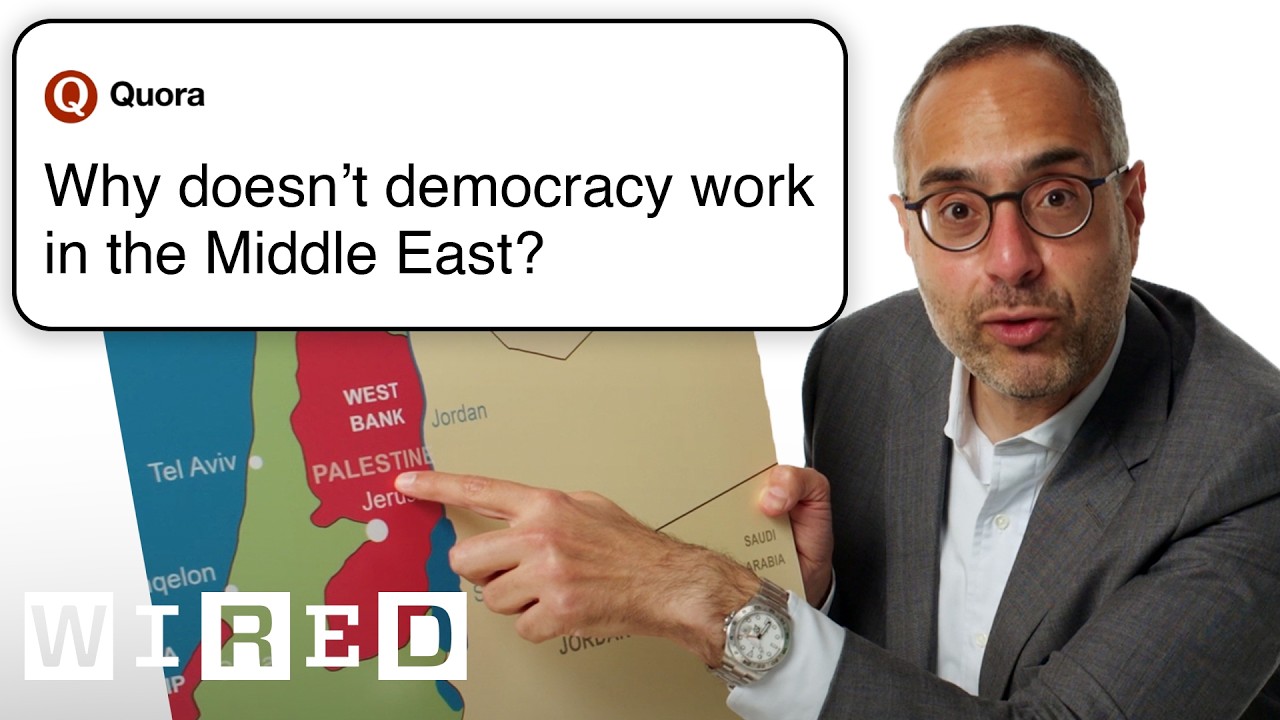
Professor Tarek Masoud joins WIRED to answer the internet’s burning questions about the Middle East. What’s the origin of the conflict between Israel and Palestine? What are the most significant moments leading to the current geopolitical climate of the Middle East? What makes the Houthis of Yemen such a difficult adversary? Why is Islam unfairly associated with terrorism? Answers to these questions and more await on Middle East support.
0:00 Middle East Support
0:15 What was the reaction to bombing Iranian nuclear sites?
1:00 The timeline
3:41 Syria, currently.
5:00 Turkey
6:56 Houthis
7:43 Democracy in the Middle East
9:16 Gaza and Genocide
11:57 Oil
12:49 UAE
14:11 What’s the origin of the conflict between Israel and Palestine?
16:54 Dubai Dudes
18:16 Two state solution
20:08 War
21:08 Sunni Muslims and Shia Muslims
22:43 Terrorism
24:40 2003 Iraq Invasion
26:11 Iran of the 1960s
28:04 Why there are American bases in Qatar?
28:35 The U.S. and Israel in the 1960s
30:12 What is Israel’s main goal with invading other countries?
33:17 Futuristic Saudi Cities of the Desert
34:32 The Taliban and women
35:41 The difference between Kosher and Halal
*EXPERT’S NOTE:* My edited response to the question about the roots of the Sunni-Shia divide seems to suggest that a civil war broke out immediately upon the death of Muhammad. In fact, the prophet Muhammad’s cousin, Ali Ibn Abi Talib, was passed over for leadership three times, before finally becoming Caliph about 25 years after Muhammad’s death. His rule, however, was highly contested. A civil war broke out, and Ali was ultimately assassinated, setting in motion the split between Shias (the partisans of Ali) and Sunnis that persists to this day.
Director: Lisandro Perez-Rey
Director of Photography: Charlie Jordan
Editor: Matthew Colby
Expert: Tarek Masoud
Line Producer: Jamie Rasmussen
Associate Producer: Brandon White
Production Manager: Peter Brunette
Production Coordinator: Rhyan Lark
Casting Producer: Thomas Giglio
Camera Operator: Lauren Pruitt
Sound Mixer: Rebecca O’Neill
Production Assistant: Caleb Clark; Ryan Coppola
Post Production Supervisor: Christian Olguin
Supervising Editor: Eduardo Araujo; Erica DeLeo
Additional Editor: Samantha DiVito
Assistant Editor: Justin Symonds
Still haven’t subscribed to WIRED on YouTube? ►► http://wrd.cm/15fP7B7
Listen to the Get WIRED podcast ►► https://link.chtbl.com/wired-ytc-desc
Want more WIRED? Get the magazine ►► https://subscribe.wired.com/subscribe/splits/wired/WIR_YouTube?source=EDT_WIR_YouTube_0_Video_Description_ZZ
Follow WIRED:
Instagram ►►https://instagram.com/wired
Twitter ►►http://www.twitter.com/wired
Facebook ►►https://www.facebook.com/wired
Tik Tok ►►https://www.tiktok.com/@wired
Get more incredible stories on science and tech with our daily newsletter: https://wrd.cm/DailyYT
Also, check out the free WIRED channel on Roku, Apple TV, Amazon Fire TV, and Android TV.
ABOUT WIRED
WIRED is where tomorrow is realized. Through thought-provoking stories and videos, WIRED explores the future of business, innovation, and culture.



Thanks, everyone, for watching. I wanted to share some readings for those who’d like to dig deeper; make a couple of corrections; and make one shameless plug:
1. As several commenters here have noted, there’s a lot more to be said about the struggle between Israelis and Palestinians for sovereignty, security, and self-determination. For an Israeli perspective, see Ari Shavit, My Promised Land: The Triumph and Tragedy of Israel (2013). For a Palestinian perspective, see Rashid Khalidi, The 100 Years War on Palestine: A History of Settler Colonialism and Resistance, 1917-2017 (2020). Neither book represents the totality of Israeli or Palestinian views of the conflict or the history of their own peoples, but they are good places to start.
2. If you’d like to learn more about the history of the current Middle Eastern state system and why it is so conflict-prone, you cannot beat David Fromkin’s weighty but eminently readable A Peace to End All Peace: The Fall of the Ottoman Empire and the Creation of the Modern Middle East (1989)
3. For a perspective on the absence of democracy in the Arab world that emphasizes the role played by West, see Elizabeth F. Thompson, How the West Stole Democracy from the Arabs: The Syrian Arab Congress of 1920 and the Destruction of its Historic Liberal-Islamic Alliance (2020). As the title suggests, the book tells the story of how a relatively liberal and pluralistic attempt at self-government in Syria was thwarted by European colonial powers. For an older, competing, and rather more controversial perspective on the absence of Arab democracy that emphasizes cultural factors internal to the Arab world, see Elie Kedourie, Democracy and Arab Political Culture (1994).
4. To learn more about Mustapha Kemal Atatürk, the man who rescued Turkey from ruin after the Ottoman Empire’s defeat in WWI, and who established today’s secular Turkish republic, read Andrew Mango’s superb (if matter-of-factly-named) Atatürk: The Biography of the Founder of Modern Turkey (1999)
5. To learn more about how oil has shaped the Middle East and the world, read Daniel Yergin’s magisterial, global history of your favorite hydrocarbon, The Prize: The Epic Quest for Oil, Money, and Power (1990).
6. Iran should be the subject of its own “Tech Support” episode. Until then, I recommend Stephen Kinzer’s All the Shah’s Men: An American Coup and the Roots of Middle East Terror (2003). That book tells the story of the American- and British-backed overthrow of Iran’s democratically-elected prime minister, Mohamed Mossadegh in 1953, which planted the seeds of the Islamic revolution that birthed the Islamic Republic a quarter-century later. For a highly personal account of Iran’s Islamic revolution, see Marjane Satrapi’s graphic novel Persepolis (2004).
7. On the transformations underway in Saudi Arabia, led by the country’s crown prince, Mohammed bin Salman (MBS), see New York Times reporter Ben Hubbard’s MBS: The Rise to Power of Mohammed Bin Salman (2021). You can also read my review of the book in the Journal of Democracy: https://www.journalofdemocracy.org/articles/the-prince/
8. On how political disputes among the early Muslim community produced the modern day split between Sunni and Shia Muslims, see Hugh Kennedy’s The Prophet and the Age of the Caliphates, 600–1050 (1986). Another book on early Islamic history worth reading is Fred Donner’s Muhammad and the Believers: At the Origins of Islam (2010). That book argues that the early Muslims were originally part of a “community of believers” that included Jews and Christians. A comforting thought in this age of religious strife.
9. Finally, a bonus recommendation is Riad Sattouf’s extraordinary multi-volume series of graphic novels: The Arab of the Future, which tells of the author’s boyhood spent between the Arab world (including Libya, Saudi Arabia, and his father’s native Syria) and his mother’s native France. Originally written in French, the first four of the six volumes are available in English.
All of the above books are fairly accessible and enjoyable, despite the sometimes-difficult subject matter.
Now for two corrections:
1. 01:20 As a few of you noted, the renaming of Constantinople to Istanbul did not happen in 1453. The Ottomans called it “Konstantiniyye.” Istanbul was an informal name that only became official in the 20th century. I am sorry for the error.
2. 22:15 In my answer on the Sunni-Shia divide, I said the Iran-Iraq war took place in the 1970s and early 80s. Though there was armed conflict between Iraq and Iran in the 1970s over the Shatt al-Arab waterway, the conflict we know as the Iran-Iraq war started in 1980 and ended in 1988. Thanks to those of you who flagged this.
Finally, the shameless plug:
If you’re interested in hearing a variety of perspectives on the Palestinian-Israeli conflict and the war in Gaza, please check out the Harvard Kennedy School’s Middle East Dialogues, a series of in-depth interviews I have been conducting with intellectuals, activists, and leaders from Israel, Palestine, the United States, and the broader Arab world: https://youtube.com/playlist?list=PL-FNnyGuM4IwUeIltpVHnNQHN6azeVUrN
Thanks, again, everyone, for watching and for commenting. And thanks to the great team at Wired for giving me the opportunity to speak to you.
Thank you so much for listing these added resources.
Man, you’re amazing, this is fantastic.
Do you record any seminars around this topic that are available? Would be an interesting watch!
Fantastic! Just a minor correction that might be needed: 1:25 Constantinople’s name wasn’t changed until 1930, nearly 500 years after it was conquered by the Ottomans. Perhaps this correction won’t matter to the viewers UNLESS they are interested in some of the changes that the modern Republic of Turkiye implemented
Tarek is a turk with anti-west sentiments.
20:47 thank you for including this! i would love to see more of the kurdish cause being talked about in these videos 🙂
Why does he feel the need to over pronounce everything?
Although this guy is Arab, he answered like a true Israeli. 🤔
Professor, why are Israeli terrorists called settlers?
Are you sure you are professor of middle east? you seem hardly know the subjet, you blame stuff about lines and such? what happen before ww1? don’t you ermember that the saudi tribes fought the ottman empire? my god you speak about subject and no aware of the history, it’s a culture thing, the arabs are tribes! you can see in the saudi arabia, with all their differnet tribes in differnet areas of the state you can see it in israel with the arabs in israel live in differnet tribes and familitles you see it in currently in gaza where they fight in gaza between each other all the time, you are dicating western views on the subject, you are no professor of the subject, it’s much more complicated, and than you make it seem like Israel or the arabs in fault here, noone of them in fault. they hate each other they start wars against each other, one lose, one win. I am sure that you won’t care if Israel will lose… you are pro arab the way you speak, no academic speak like this, you need to be boycotted, you should not be professor at this subject, just take a real person who live there and can teach you more than him
He had a few minutes to condense a lot of complex information, stop being foolish.
@ReignOfGamefew minutes? So don’t talk like pro Arab use facts, he didn’t use any facts, Palestine was not exist before the British took over, he base all his words on lies, that’s like saying the world is flat and base physics on it
@KingStructre “Roman authorities renamed the province of Judaea to “Syria Palaestina” in c. 135 CE”
7:45 iraq is a democracy 😐
5:03 Ben senin o Turkiye’nin yarisina Ermenistan yazan Arap kokunu alirim. At kafasi bir de Ortadogu’daki tek demokrasiye Israil diyor. 😂
Bc it is a tribalism society.
🤦♂️
Freedom for Israel AND Palestine. We ALL deserve to be free. Both sides have committed atrocities. Both sides have good points. Both sides have a right to life and happiness.
I am a Jew for freedom because all people are my people. It breaks my heart how few people few the same way and how often I’m attacked for saying peace and understanding is the only acceptable outcome.
Forgot to mention, their skydaddy tells them to murder anyone who doesn’t believe in the skydaddy.
That is a major issue with a lot of muslims, not all, some agree its a bad idea.
Just like for the christians, most christians don’t actually follow 75% of what the bible says/
Really great video!
If you want crime rates to plummet, make housing, food, and healthcare, human rights.
Long term it will actually save money.
Let the Israelis divide the area in half any way they want to.
Then let Palestinians choose first.
Charlatan and not a middle east expert. You can tell when he brings up “Colonialism” which is a conspiracy theory by Baathist arabs. He is stooped in propaganda. Not a historian but okay putting up fact professors like you wanna do to destroy your credibility.
How is Israel the only democracy in the middle-east? I thought he established that Turkey is also in the middle-east. Is Turkey a dictatorship now? Turkey’s democracy is flawed, but so is Israel’s. By what standards is Israel the only democracy in the middle-east?
The middle east can’t handle or want democracy. The very nature of their culture DEMANDS and expects a “strong man” figure head. You can’t have a democracy with a dictator or King. Hence why Middle East will never be a democracy
7:46 last I checked Turkiye is a democracy. The fact that people voted majority Erdogan was a decision that lies with the people. Sure it isn’t perfect but it still relies on the will of the people.
11:00 Of course it was genocide in Gaza